 Wheeler Works

Legionfall
LEGIONFALL is a free, browser-based multiplayer strategy game — a fan tribute to the 1980s board game Titan. Command a Titan and its growing armies of mythic creatures: march legions across an overworld, recruit monsters, and clash with rivals on tactical hex battlefields. Play with friends over a shareable link or against AI — no download, no sign-up. The last Titan standing wins.
Play it: https://legionfall.us · Free · No account required · Runs in any modern browser (desktop & tablet)
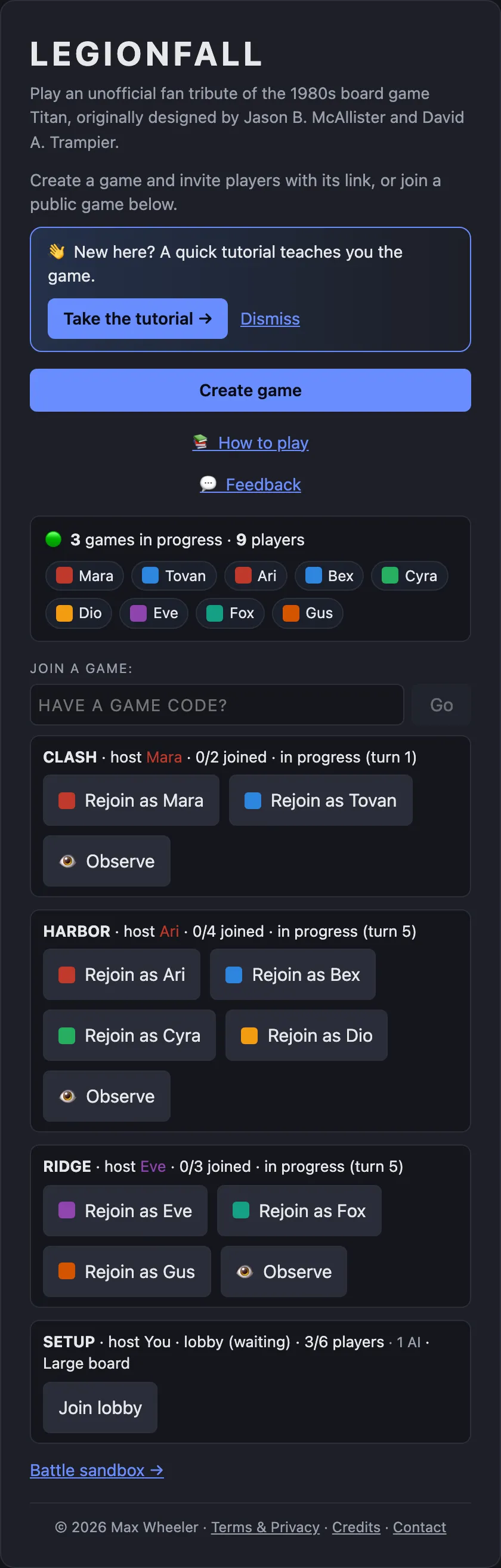 The home screen — start a game, join a public one, or enter a code. A live panel shows how many games are in progress and who’s playing right now.
What it is
LEGIONFALL is a fantasy battle game of growing armies. Each player commands a Titan and a band of legions that march across a shared overworld and collide on tactical battlelands. Recruit ever-mightier creatures from the terrain you occupy, maneuver for position, and try to destroy your rivals’ Titans before they destroy yours. Lose your Titan and you’re out; the last player standing wins.
It’s a faithful, from-scratch reimplementation of the beloved 1980s board game Titan — brought online with everything the tabletop version couldn’t offer: instant setup, shareable invite links, AI opponents, an in-app tutorial, and a rulebook you can search.
How a turn works
Play is turn-based and easy to learn but deep to master. Each of your turns runs through three phases:
- Commencement — you may split a legion, peeling creatures off into a new stack. Splitting is how your army multiplies across the board, but it spreads you thin: both halves must keep at least two creatures.
- Movement — roll the movement die and march your legions. Move into a land already holding an enemy legion and you start an engagement — a battle.
- Enlistment — every legion that moved may muster one new creature from the terrain it now stands on. Hills breed different monsters than marshes or mountains, so where you go shapes what you can recruit.
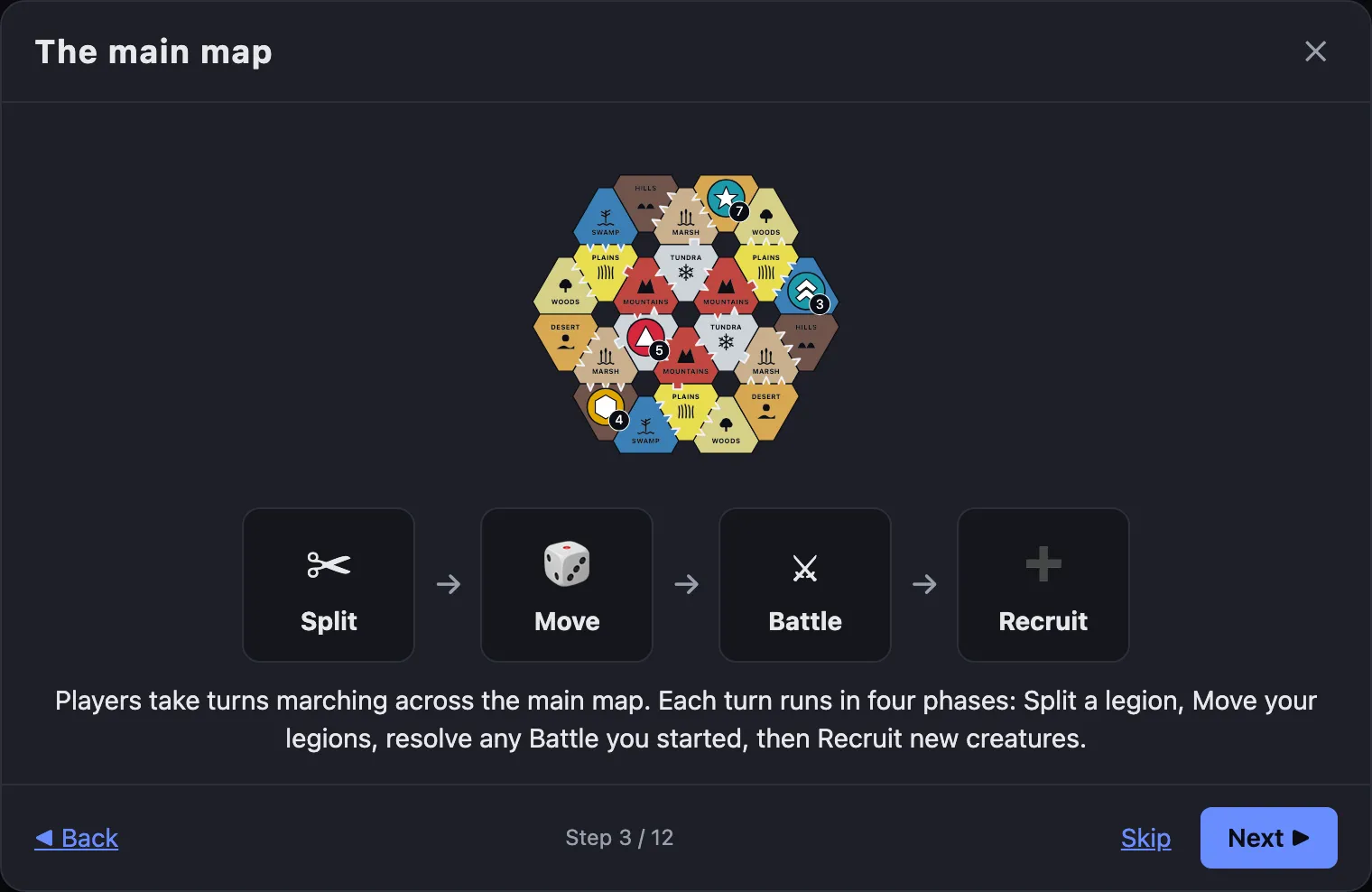 The main map, with legions (the numbered tokens) spread across the terrain — and the four phases of every turn: split a legion, move, resolve any battle, then recruit. (Shown in the game’s built-in tutorial.)
Battles
When two legions meet, the game drops into a battleland — a hex map with its own terrain, hazards, and native advantages. This is where LEGIONFALL earns its name.
Every creature has two factors: Power (how many dice it rolls when it strikes, and how many hits it can take before it falls) and Skill (how far it moves and how accurately it strikes). A creature’s point value is simply Power × Skill. In battle you maneuver your creatures, then resolve strikes in close combat and rangestrikes from afar — with bonuses and penalties from terrain, elevation, and whether a creature is fighting on its native ground. Positioning matters as much as raw strength: a well-placed line can grind down a bigger stack.
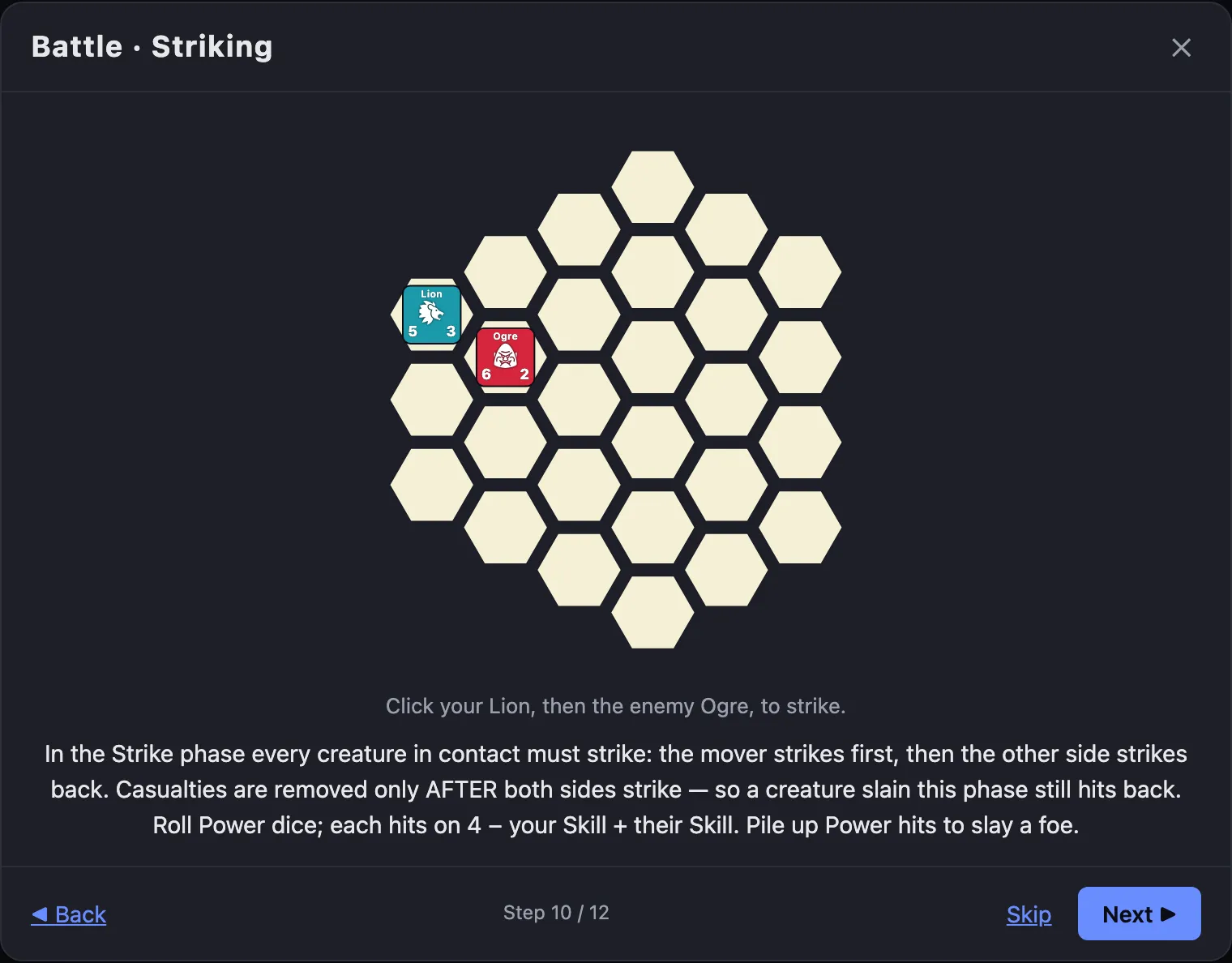 A battle on the 27-hex arena — here a Lion (Power 5 / Skill 3) meets an Ogre (Power 6 / Skill 2). Creatures in contact strike each other; Power sets the dice rolled and hits absorbed, Skill the reach and accuracy. (Shown in the game’s built-in tutorial.)
Growing your legions
Winning battles is only half the game — the other half is building an army worth fielding. Mustering lets each moving legion recruit a creature from its terrain, climbing a ladder from humble Centaurs and Ogres up to Wyverns, Giants, Dragons, Hydras, and Colossi. Score enough points and you can summon Angels and Archangels — flying lords that can be teleported straight into a battle to turn the tide.
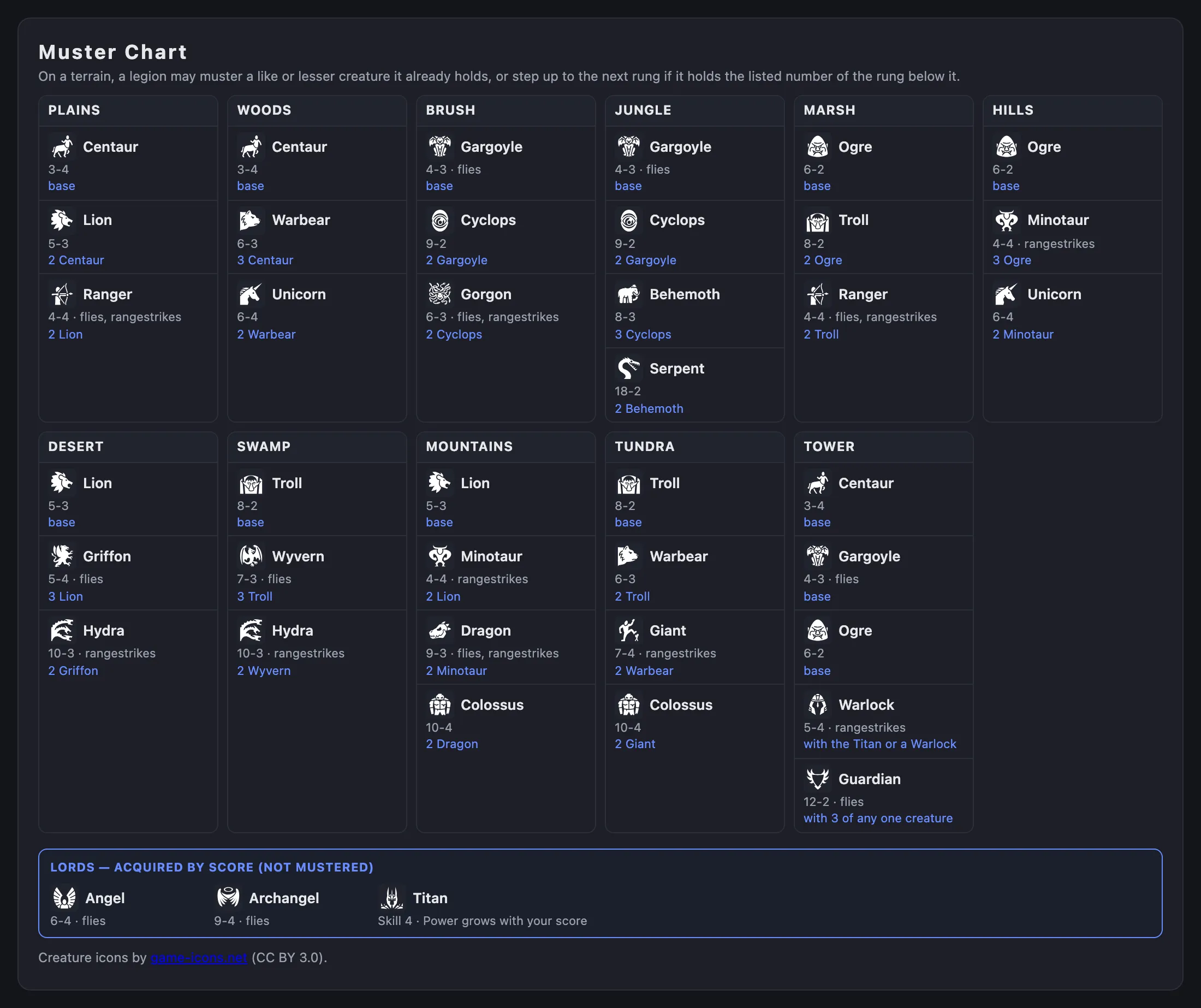 The built-in muster chart — a live reference for what each land recruits and how the creature ladder climbs.
Winning
Win a battle and you eliminate the loser’s legion and add its point value to your score. Slay a player’s Titan and that player is out. When only one player remains, they win.
Scoring feeds back into power: a Titan’s Power grows with its owner’s score — it starts at 6 and gains +1 for every 100 points, so a player who’s winning becomes steadily more terrifying, and at 400 points the Titan even unlocks a teleport. Momentum is real, but so is overreach: spread too thin and a rival can pick you apart.
Playing with others (or against the computer)
LEGIONFALL is built for real games with real people, with none of the setup hassle:
- One-click games and invite links — create a game and share its link; friends join in a tap. No accounts, ever.
- Public or private — list your game for anyone to join, or keep it invite-only with a code.
- Play against AI — fill any seat with a computer opponent across five personalities: Smart, Hard, Aggressive, Peaceful, and Easy — great for learning, for odd player counts, or for a quick solo game.
- Observers — let spectators watch a game in progress.
- Rock-solid reconnection — close your laptop, lose Wi-Fi, or reload mid-turn and you drop right back into your seat. Games survive disconnects and even server restarts; nobody is ever knocked out for a dropped connection.
- Desktop turn alerts — opt in to a notification when it’s your move, so a slow game doesn’t need you staring at the tab.
- Learn as you go — a built-in “How to play” walkthrough teaches the game, and a searchable Rules & Help panel answers questions in plain language while you play.
- Installable — add it to your home screen or desktop like an app; works on tablets too.
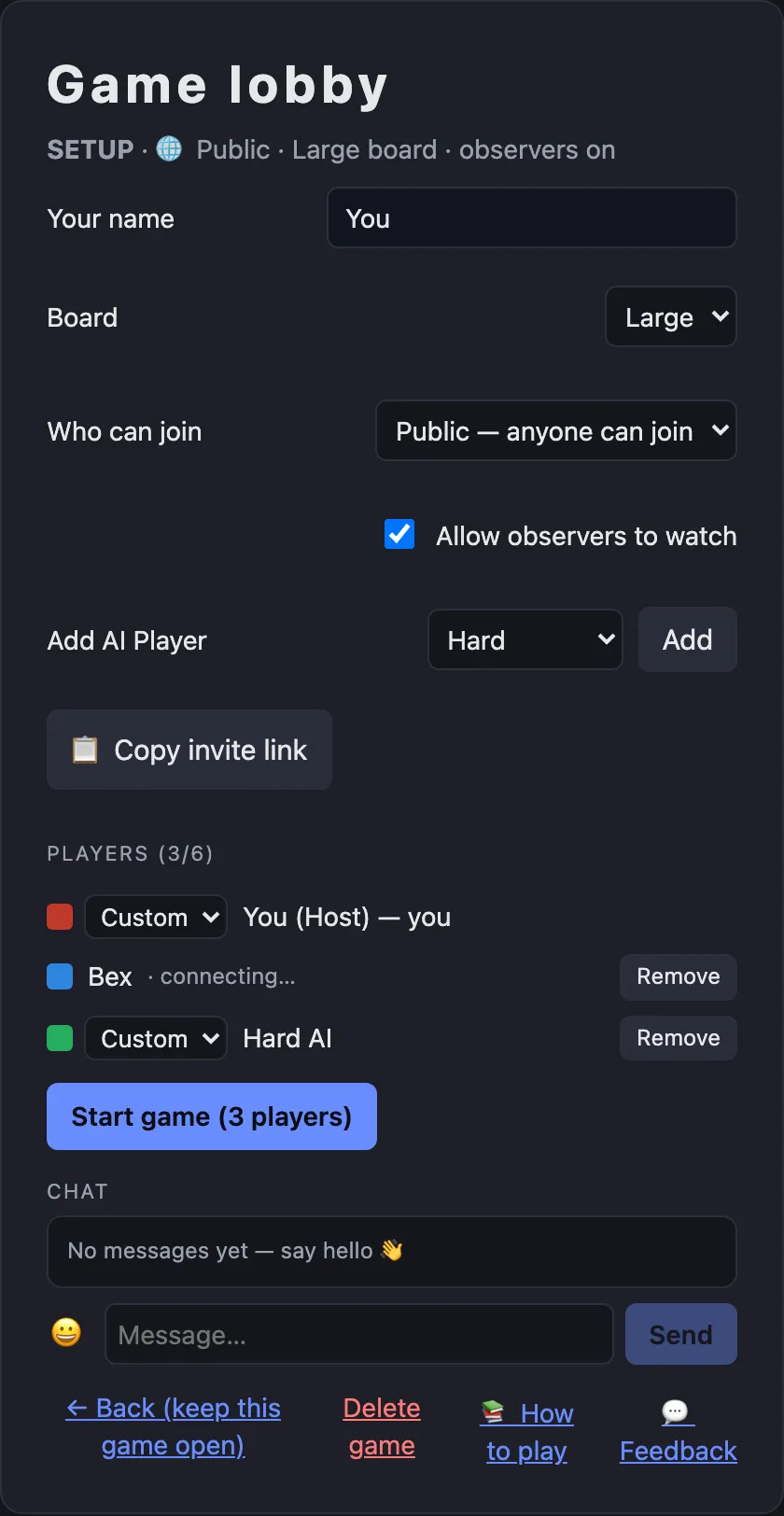 The lobby — gather players, add AI opponents, choose the board size, and set who can join before you start.
About
LEGIONFALL is an unofficial fan tribute to Titan, the 1980s fantasy board game originally designed by Jason B. McAllister and David A. Trampier. It’s a clean-room reimplementation — an homage built for the love of the game, not affiliated with or endorsed by the original’s rights holders. Creature artwork is adapted from game-icons.net under CC BY 3.0.